
Your menu prices only work if your recipe costs are right. We build and maintain accurate recipe costing inside R365 so every dish reflects its true cost, not a guess.
Your plate cost and your P&L food cost don't match
Recipes were entered once and never updated when prices changed
Units of measure don't match between vendor invoices and recipes
Yields and prep loss were never factored into the cost
New menu item get priced without knowing real cost
Theoretical food cost looks fine on paper but actual cost keeps climbing
Recipe costing is not data entry task. It is the foundation your entire food cost strategy sits on. At Restaurant Smith, we build recipe costing the way an operator who has priced a menu sat through a food cost meeting would build it, not the way a software manual describes it.
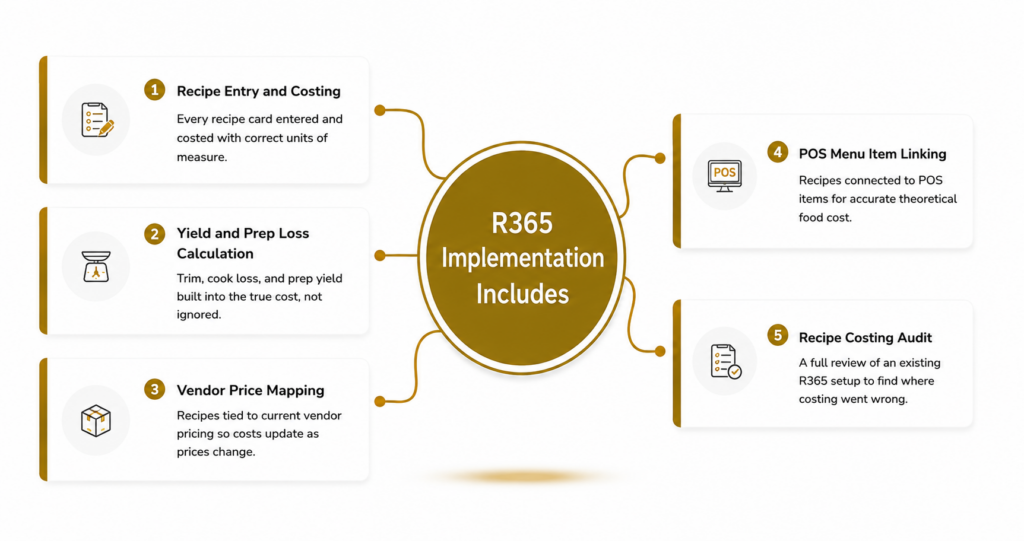
We start with your actual recipe cards and vendor invoices, not the assumptions. Every ingredient gets mapped to the correct unit of measure, every yield and prep loss gets factored in, and every recipe gets linked to your POS menu item so your theoretical cost updates automatically as vendor prices change. This is the same recipe build work covered in our R365 Implementation process, applied specifically to operators who need their costing fixed without a full system rebuild.
If your recipes were entered quickly just to go live, or costing was never revisited after your first few vendor price increases, your all numbers are already off. We rebuild that foundation so your food cost reporting means something again.

When a recipe is costed wrong, the error does not stay in one place. It flows into your theoretical food cost, into your variance reports, into your menu pricing, and into every purchasing decision built on top of it. A missing yield percentage or a wrong unit of measure conversion can quietly inflate or deflate a dish’s true cost, and that gap repeats every time the dish sells.
Operators usually notice the symptom before the cause. Food cost the percentage creeps up with no clear explanation, a bestseller turns out to be barely profitable, or Theoretical vs. Actual reports never line up no matter how tight the counts are. The recipe costing is the almost always the source. Fixing it once, correctly, stops to the error from repeating on every ticket.
We review your existing recipes, vendor pricing, and unit of measure setup to find exactly where the numbers break down.
We rebuild each recipe with correct units of measure, accurate yields, and verified vendor pricing so the cost reflects what actually happens in the kitchen.
Every recipe gets mapped to its POS menu item, so your theoretical cost updates automatically as ingredient prices move.
We compare theoretical cost against your actual usage to confirm the numbers hold up in real service, not just on paper.
You get recipe-level cost reporting you can use for menu pricing, vendor negotiation, and margin decisions going forward.
Built through the lens of a real restaurant operator. av
Trim, cook loss, and prep yield built into the true cost, not ignored.
Recipes tied to current vendor pricing so costs update as prices change.
Recipes connected to POS items for accurate theoretical food cost.
A full review of an existing R365 setup to find where costing went wrong.
This is for operators on R365, or moving to R365, who need recipe costing that actually holds up against real usage. Whether you run a single location independent restaurant and never got recipe costing set up right, operate a fine dining concept where portion and yield precision matters most, or manage a multi-location restaurant chain trying to keep food cost consistent across units, accurate recipe costing is the starting point.
If you’re already working with us on a broader R365 implementation or data cleanup and COGS repair, recipe costing is often the piece that gets fixed first, since every other report depends on it.
Four Services tier designed to meet you exactly where you are
Ideal for: Owners who have recipe cards but no time to enter and cost them.
Ideal for: Operators who have recipes in the system but don’t trust the cost.
Ideal for: Operators who want recipe costs to stay accurate as prices and menus change.
Recipe costing focuses specifically on your recipes, yields, units of measure, and vendor pricing. Full R365 implementation covers that plus inventory setup, AP workflows, and manager training. Many operators start with recipe costing alone if that’s the specific gap in their system.
A single-location menu with a moderate recipe count typically takes 1 to 3 weeks. Larger menus or multi-unit operations with more complex recipes may take 4 to 6 weeks depending on how much cleanup is needed.
Yes. This is one of the most common requests we get. We audit the existing recipes, identify where units of measure, yields, or vendor pricing are wrong, and rebuild them correctly rather than leaving the errors in place.
Yes. Restaurant Smith is Colorado-based but works with operators remotely across the country. Recipe costing is delivered fully remotely with no impact on accuracy.
Recipe costing is not a one-time fix. Our ongoing tiers include regular reviews so new menu items and vendor price changes get reflected in your cost data instead of going stale.
Let's talk about where your recipe costing stands today and what it should be telling you.

At Restaurant Smith, we build your R365 system through the lens of a multi-unit operator.